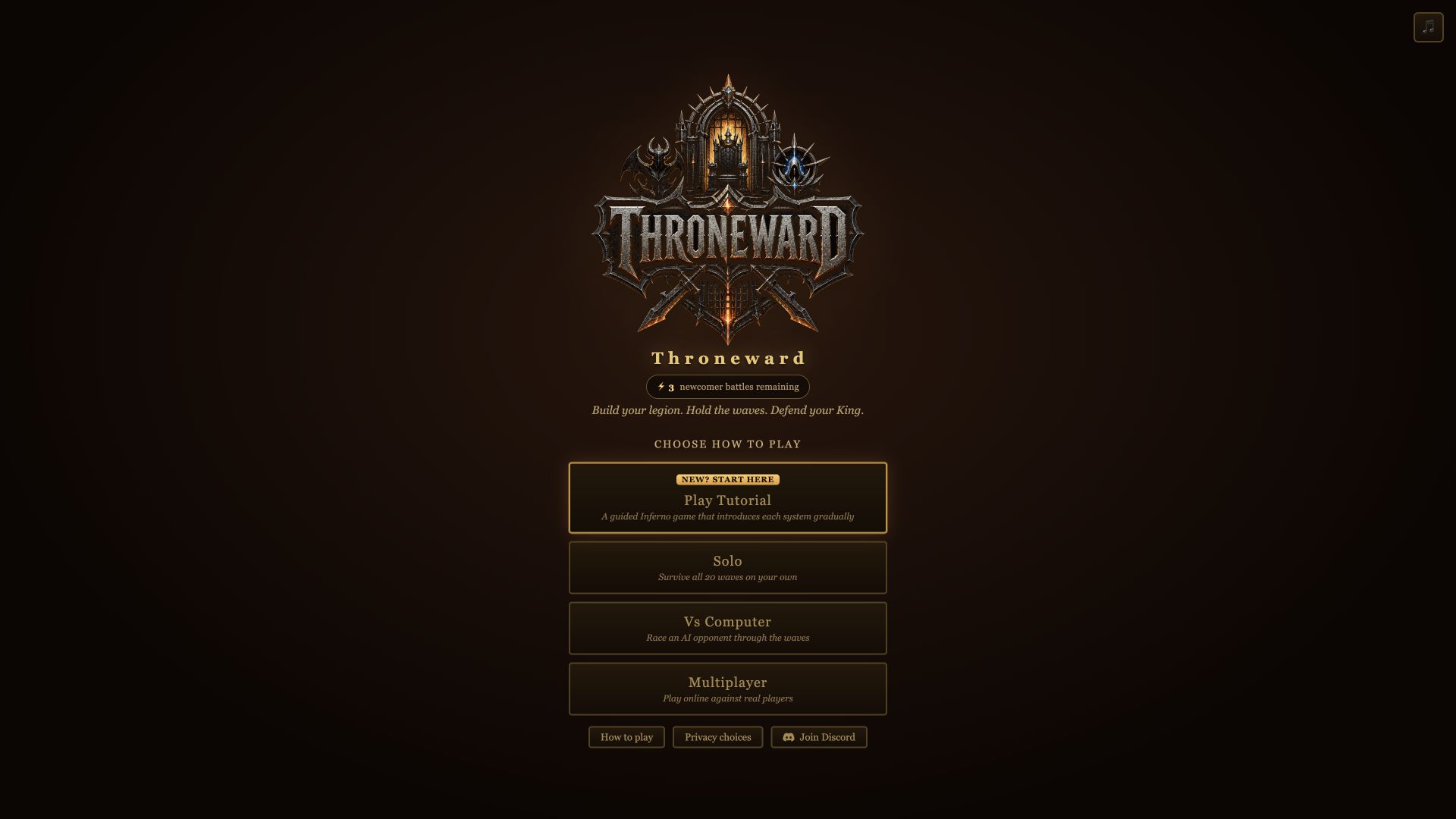
Throneward multiplayer in 60 seconds
- RankedRated 1v1 matchmaking is live. Opponents are paired by rating; results update your rating, leaderboard position and match history.
- CasualPublic, unranked games support 1v1, 2v2, 3v3 and 4v4. Choose a size to join an open lobby or create one.
- PrivateCode-only, unranked lobbies support 1v1 through 4v4, free team selection and host-controlled bots.
- PvP pressureYour mercenaries join a fixed opponent's next wave while permanently increasing your income and shared King upgrades.
- VictoryDestroy the enemy King before Wave 20, or win the final arena. A drawn final arena goes to the healthier King.
Choose the right online mode
Every online mode requires a Throneward account. After signing in, choose a legion before entering matchmaking or a lobby. Your saved choice follows you into the queue, and you can inspect every legion's fighters and abilities from the class selector. Use the legions comparison to pick a roster you can pilot under the online build timer.
Ranked 1v1
Matched against another human by rating. Teams are fixed, bots are not allowed and the result changes both players' ratings.
Competitive ladderCasual 1v1–4v4
Public and unranked. Quick Match fills the fullest open lobby of your chosen size or creates one for others to join.
Low-stakes PvPPrivate 1v1–4v4
Code-only and unranked. Choose teams and classes, add easy, normal or hard bots, then ready up together. See the invite walkthrough.
Friends and custom teamsVs Computer 1v1–4v4
Offline practice against AI on easy, normal or hard. It follows the same lanes, shared-King and arena rules without affecting a rating.
How a PvP match works
- Build your own lane.Spend gold on fighters and workers during the timed build phase. Every player controls a separate six-by-four formation.
- Scout the other fields.All lanes remain visible as live views. Select a teammate or enemy thumbnail to inspect their formation, economy direction and current fight.
- Ready up.Your button locks you ready. The wave begins when every human is ready or the build timer ends; clicking again before the start cancels readiness.
- Defend the scheduled wave and sends.Every lane receives the same base wave. Mercenaries sent by the opposing side join the tail of the targeted lane's next wave.
- Resolve leaks at the King.Creeps that cross a board enter that team's King's Court. The throne fights back, and surviving allied fighters can rush over after clearing their own lanes.
- Rebuild, send and repeat.Collect gold and mythium, adapt to what you scouted, and prepare for bosses on waves 5, 10, 15 and 20.
Combat is server-authoritative and automatic. Your competitive decisions are made through formation, economy, scouting, send timing and readiness—not by issuing orders during the fight.
Scout first, then decide whether to send
In 1v1, every hired mercenary joins your opponent's next wave. In team modes, each player has a fixed opposing lane; you do not retarget every individual send. The mercenary appears after the scheduled wave units, while you keep its permanent income and random King upgrade even if it dies.
Use a cheap tier when no clear weakness is visible and you want the permanent gold bonus to start compounding sooner.
Bank with a named target: a boss, rush or heavy wave that already looks difficult for the opponent's current roles.
Workers and sends are future strength. If the next wave can break your formation, spend current gold on defense first.
Look for concrete signals rather than guessing from total fighter cost:
- Too little frontline: fast or durable pressure can expose expensive backline fighters early.
- Slow clears: a mercenary added to the tail can arrive while the defender is still occupied.
- Tight clustering: slam effects from 80- and 160-mythium mercenaries can punish a compressed wall.
- One-dimensional damage: a board built to crush small packs may struggle against a large, durable body.
Use the mercenaries guide for the complete rotating roster, abilities and counters, or the economy guide for worker and payout timing.
A practical ranked 1v1 plan
- Choose a legion you can pilot under a timer. Ranked is a poor place to learn an unfamiliar roster's costs and roles. Use Tutorial or Vs Computer first.
- Prioritize clean information. A reliable early wall lets you scout while the enemy still fights. A frantic late clear leaves less time to plan.
- Separate income sends from kill sends. Cheap early sends grow your economy; a saved large send should line up with a scouted weakness and difficult base wave.
- Track both Kings. A small leak can matter more than the lane fight suggests because King health becomes the final tiebreak after Wave 20.
- Prepare for direct combat. Your formation fights the opposing formation after waves 10 and 20, so a wall optimized only for creeps may reveal a PvP weakness.
Your opponent clears Wave 7 late and their ranged damage is tightly packed behind one durable unit. Instead of sending a cheap mercenary immediately, you save toward an 80-mythium Wall Breaker for a later pressure wave. Its body extends the fight and its ground slam threatens the exact cluster you scouted. If your own lane becomes unstable before then, abandon the timing and defend—the send is not worth losing first.
Team PvP is built around one shared King
In 2v2, 3v3 and 4v4, each player owns a separate board, gold total, worker count and mythium pool. Everyone on one side shares the same King and its mercenary-earned upgrades. One failing lane can therefore damage the entire team, while one fast clear can rescue it.
When your lane clears and a teammate's creeps have reached the court, your surviving fighters deploy to defend the throne. Fighters still occupied in their own lane stay there until they finish. This makes clear speed a team resource: holding safely is good, but clearing with survivors can prevent King damage elsewhere.
- Use Team chat to coordinate saved sends, boss preparation and a lane that needs help.
- Do not duplicate every role. Each board must survive independently, but different legions can cover different arena strengths.
- Watch the weakest lane. Team victory is constrained by the shared King, not by the strongest player's personal record.
- Remember shared upgrades. Every teammate's mercenary sends add levels to the same team King.
How arena battles work
Versus modes hold direct army battles after waves 10 and 20. The arena uses full copies of every active player's placed fighters; your actual boards are untouched, fallen arena copies cost no gold and the arena itself pays no gold or income.
Mid-game arena: information plus comeback
You receive a dedicated 20-second prep phase, followed by a 10-second staredown and a battle capped at 90 seconds. The losing team's King heals for 25% of maximum HP. The match then continues to Wave 11.
Comeback checkpointFinal arena: winner takes the match
The same prep and battle sequence becomes the final verdict. If neither army wins outright, total surviving arena HP breaks the timeout. A complete arena draw goes to the team with the higher King HP percentage; equal Kings produce a draw.
Final deciderThe arena's most important lesson is revealed after Wave 10, while there is still time to respond. Notice which frontline collapses, whether ranged units fire immediately and whether support abilities affect enough allies. Add to the formation during later waves instead of panic-selling established fighters for a 60% refund. The unit placement guide shows how to diagnose those first-contact, range and coverage problems.
Every PvP win condition
Enemy King falls
The enemy team is eliminated immediately, even before Wave 20.
Final arena win
The army that wins the post-Wave-20 arena wins the match.
King-health tiebreak
If the final arena draws, the higher surviving King HP percentage wins.
True draw
If the final arena and King-health comparison are both tied, the match is recorded as a draw.
A 1v1 disconnect has a 60-second reconnect window by default. If the player does not return, the seat forfeits. In team modes, a normal-difficulty bot takes over an abandoned seat after the grace period so the remaining players can continue; a returning player can reclaim control.
How ranked rating works
New accounts begin at 1,000 rating. Ranked results use an Elo calculation with a K-factor of 32: beating a higher-rated opponent is worth more, while losing to one costs less. Casual and private results do not change rating.
The multiplayer home shows the top 20 leaderboard entries and your ten most recent 1v1 matches, including opponent, result, finishing wave and rating change. Matchmaking starts with a tighter rating range and widens as someone waits, balancing similar opponents against practical queue times.
Seven PvP mistakes to avoid
Never scouting
Total fighter cost does not reveal role balance, spacing or clear speed. Look at the actual opposing lane.
Sending without a purpose
Choose between early income and a later kill timing; drifting between both wastes their strengths.
Greeding on a weak wall
An economic lead disappears if your King falls before future income can be collected.
Ignoring King health
Damage taken early can decide a drawn final arena twenty waves later.
Solo play in a team mode
Track allied lanes, use Team chat and remember that every leak reaches the same throne.
Forgetting Wave 10
The mid-game arena directly exposes army-vs-army weaknesses and grants a comeback heal.
Panic rebuilding for arenas
Late fighter sales return 60%. Prefer targeted additions over burning 40% across a whole board.
Your first PvP checklist
- Learn one legion offline so the online build timer is used for decisions, not reading every card.
- Start in Casual 1v1 if you want the full PvP rules without risking rating.
- Scout after every clean clear and name the opponent's weakest role before choosing a send.
- Prepare before waves 5 and 10 instead of buying a worker immediately before the first boss or arena.
- Keep both Kings visible in your plan because team defeat and the final tiebreak are decided at the throne.
Ready to test your wall against a player?
Open Throneward in your browser, sign in and choose Ranked, Casual or Private from the Multiplayer menu.
Play multiplayer free