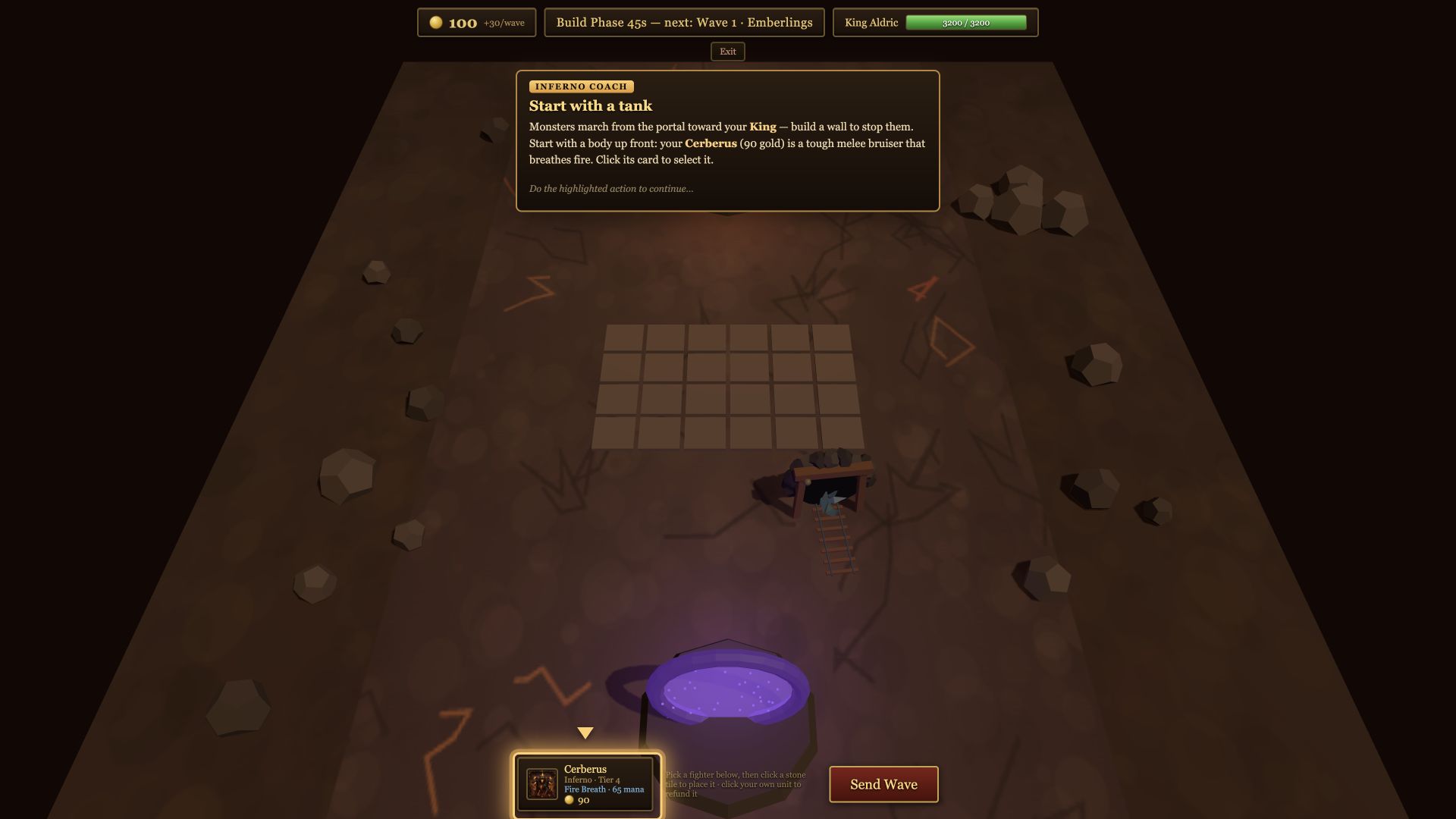
Throneward economy in 60 seconds
- GoldBuys fighters and 60-gold workers. You earn a scheduled payout after every cleared wave, plus creep bounties.
- WorkersProduce 8 mythium each after every cleared wave. They contribute no health or damage to your formation.
- MythiumBuys mercenaries. In PvP they reinforce an opponent's next wave; in Solo they fight beside you for one wave.
- IncomeEvery mercenary permanently increases your gold payout and upgrades one random King stat.
- The core ruleTake economy only from a board that can still clear. A worker is valuable only if your King survives to collect its returns.
Understand the complete resource loop
- Clear waves to earn gold.Gold arrives from the scheduled wave payout and from bounties when enemies die.
- Split gold between fighters and workers.Fighters make the next clear safer. Workers cost 60 gold and produce 8 mythium per future clear.
- Spend mythium on mercenaries.The hired unit affects the next battle, permanently adds income and grants King upgrade levels.
- Collect higher gold payouts.Permanent income is added to every later cleared wave, giving you more gold for fighters or additional workers.
How much gold does each wave pay?
After clearing Wave N, every player receives a scheduled payout of 25 + 5N + permanent income. Creep bounties are separate and are awarded as enemies die, including enemies that leak into the King's Court and are killed there.
| Wave cleared | Base payout | With +10 income | Bounties | What this means |
|---|---|---|---|---|
| Wave 1 | 30 gold | 40 gold | Added separately | Early purchases depend heavily on small creep bounties |
| Wave 5 | 50 gold | 60 gold | Added separately | The first boss also carries a valuable bounty |
| Wave 10 | 75 gold | 85 gold | Added separately | Income has now paid repeatedly if it was earned early |
| Wave 15 | 100 gold | 110 gold | Added separately | Late boards can fund expensive fighters more quickly |
| Wave 20 | 125 gold | 135 gold | Added separately | The final payout occurs after the last wave clear |
The base payout naturally rises as the match progresses, but fighter costs rise too. Income matters because it repeats. Ten income earned before Wave 6 is worth 10 extra gold after Wave 6, another 10 after Wave 7, and so on for as long as your team remains alive.
When should you buy a worker?
A worker costs 60 gold and produces 8 mythium after every cleared wave. Hire it during a build phase and it begins producing after the wave you are about to fight. The earlier it is bought, the more payouts it can generate—but the 60 gold is unavailable for your formation immediately.
Your frontline stayed healthy, damage dealers remained protected and the King took no pressure. The board may have room to invest.
Your fighters won, but the frontline collapsed or stragglers nearly escaped. Spend enough to remove that weakness first.
A worker cannot repair a failing wall. Add health, damage or better role coverage before taking more economy.
Next-wave type matters as much as the last result. A board that handled a swarm may still be vulnerable to a fast rush, ranged pack, heavy wave or boss. Be especially cautious with new workers immediately before waves 5, 10, 15 and 20.
Example: 88 gold after Wave 2
Consider the coached Inferno opening from the beginner guide. You start with a 90-gold Cerberus, clear Wave 1, then add a 40-gold Imp. If every enemy from the first two waves is killed, the ledger before Wave 3 looks like this:
The worker button is affordable, but that does not make it correct. Buying one leaves 28 gold and sends the existing Cerberus–Imp pair into a 32-unit fast rush without another fighter. For a first run, reinforcing is safer unless Wave 2 was exceptionally comfortable or your chosen builder already supplies an economic advantage.
If you do buy the worker before Wave 3 and clear waves 3, 4 and 5, it produces 24 mythium. That is enough for a 20-mythium mercenary after the first boss. The send adds +2 permanent income and one random King upgrade level—but only because the formation survived three waves without the missing 60 gold.
How mythium becomes permanent income
Each match offers four mercenaries drawn from a sixteen-unit pool, one from each price tier. The exact units rotate, but their economic values stay fixed:
| Mythium cost | Permanent income | King levels | Mythium per +1 income | Battlefield value |
|---|---|---|---|---|
| 20 | +2 gold / wave | 1 | 10.0 | Fast disposable unit |
| 40 | +5 gold / wave | 2 | 8.0 | Solid bruiser |
| 80 | +11 gold / wave | 3 | 7.3 | Support effect: slow, heal, shield or slam |
| 160 | +24 gold / wave | 8 | 6.7 | Large body with a stronger support effect |
This creates the central send decision. A cheap mercenary earns less per mythium, but its income starts sooner. A large mercenary is more efficient and far more likely to influence the battle, but mythium sitting in the bank provides no current income, King upgrade or pressure. The complete mercenaries guide lists all sixteen bodies, effects and counters.
- Send early when you want reliable compounding and do not see a specific opponent weakness worth saving for.
- Save deliberately when a larger body or support effect lines up with a wave that already challenges the target formation.
- Avoid accidental banking. “I am saving for 80 on Wave 8” is a plan. Repeatedly forgetting to open the mercenary panel is not.
Every send also strengthens your King
When you hire a mercenary, all of that tier's upgrade levels roll into one random royal stat. The upgrade remains even if the mercenary dies:
Royal Wrath
Each level adds 8 King damage.
Castle Walls
Each level adds 220 maximum HP and the same amount of current HP.
Royal Vigor
Each level adds 1.2 King health regeneration per second.
Royal Tempo
Each level accelerates attacks; cooldown is divided by 1 + 0.06 × total Tempo levels.
A 160-mythium send grants eight levels to one roll. That can mean +64 damage, +1,760 maximum HP, +9.6 regeneration per second, or a base attack cooldown divided by 1.48. You cannot choose the stat, so view upgrades as durable team strength rather than a guaranteed fix for one weakness.
In Solo, the mercenary fights beside your formation for the next wave. In versus modes, it joins an opponent's next wave. In both cases, the sender keeps the permanent income and King upgrades.
Fortune and Random have special worker timing
The two variable-roster builders have economic perks that change their opening:
Fortune
Starts with one free worker, so it produces 8 mythium after each clear from Wave 1 onward. After clearing Wave 5, it gains a second free worker, which begins producing after Wave 6.
Fastest opening economyRandom
Starts without a worker, but gains one free worker after clearing Wave 5. Because the grant happens after that wave's payout, its first 8 mythium arrives after Wave 6.
Fortune pays for the advantage with an unpredictable cross-legion roster. Random receives one coherent themed legion and a later economic boost. Every other legion buys workers normally for 60 gold.
Protect gold from avoidable losses
Economy is not only about earning more. It is also about avoiding expensive corrections. A fighter sold in the same build phase it was placed refunds 100%; after it has fought, selling returns only 60% of its cost.
- Use Undo before combat. It can reverse fighter placements, sells, worker purchases and mercenary sends from the current build phase.
- Do not rebuild a whole formation after one weak wave. Add the missing role or adjust with new placements before accepting several 40% losses.
- Think before pressing Ready or Send Wave. Once combat starts, the current build's undo stack is gone and every placed fighter becomes a late sale.
Six economy mistakes to avoid
Buying workers from hope
A barely surviving wall has not created surplus. Stabilize before turning 60 gold into future value.
Never buying workers
Maximum safety now can leave you without mythium, pressure, King upgrades or enough late-game income.
Ignoring boss timing
Economy purchased just before waves 5, 10, 15 or 20 has less time to repay and may cost the needed upgrade.
Banking without a target
Large sends are powerful, but unspent mythium creates no income. Decide which tier and wave you are saving for.
Confusing gold with income
Your current gold is spendable now. Income is only the permanent bonus added after future cleared waves.
Panic selling
Late sales lose 40% of fighter value. Incremental fixes are usually kinder to both the board and economy.
The build-phase economy checklist
- Read the next wave. Identify rush, ranged, heavy and boss threats before spending.
- Judge the last clear. If the wall was unstable, budget for the role that failed.
- Check the worker opportunity cost. Know exactly which fighter purchase the 60 gold would postpone.
- Choose a mythium plan. Send now for compounding or name the tier and wave you are saving toward.
- Use Undo if the plan changes. Correct the build before committing it to combat.
Practice the first worker decision
Start the free tutorial, clear the opening waves and make the economy call from what your formation actually shows you.
Play Throneward free